SEO Writing Technical Writing

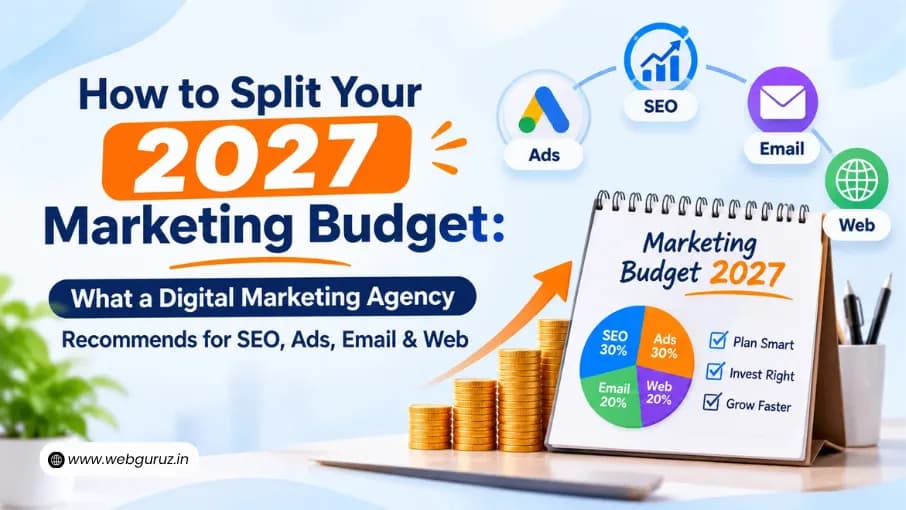
How to Split Your 2027 Marketing Budget: What a Digital Marketing Agency Recommends for SEO, Ads, Email & Web

Author
By Vedanshi

Published On:2026-11-23

0
View:0
singleblog

Most businesses are planning their 2027 marketing budget right now, and most feel the money won’t stretch far enough. Gartner‘s 2026 CMO Spend Survey found that 56% of marketing leaders say they lack the budget to deliver their strategy.

When money is tight, how you split it matters as much as how much you have. Spread it too thin and nothing works well. Put it all in one channel, and you take on unnecessary risk.

This guide walks through how an experienced digital marketing agency would approach the split: how much to spend in total, where each dollar should go, and how to adjust during the year.

Step 1: Decide Your Total Budget

Smart Marketing Budget Plan

Before splitting anything, settle on the total. Two benchmarks help:

  • For small businesses: the U.S. Small Business Administration has long suggested that businesses with under $5 million in revenue spend 7 to 8 percent of revenue on marketing, assuming profit margins of 10 to 12 percent.
  • For larger companies: Gartner’s 2026 survey puts the average at 7.8% of company revenue, though most of its respondents earn over $1 billion a year.

So a business with $1 million in annual revenue might set aside $70,000 to $80,000, or roughly $6,000 a month. Newer businesses, those launching something new and those in crowded markets often spend more. Businesses with thin margins should start lower.

One practical tip: decide how much of the total goes to people and tools, and how much goes to paid media. Ad spend is easy to forget when comparing agency quotes, and it can be the largest single line. If your website needs a rebuild, budget for that separately too, since website development services are usually a one-off project rather than a monthly cost.

Ads Lead While Web Shares

Step 2: Split the Budget Across Channels

The split below is a common starting point for a small or mid-sized business. Treat it as a first draft, then adjust it for your type of business using the table further down.

Website build and upgrades (about 10%)

Every other channel sends people to your website, so it has to work. If pages load slowly, look broken on a phone, or make it hard to get in touch, the money you spend on ads and SEO quietly leaks away.

Set aside part of the budget for planned improvements, such as faster pages, clearer service pages, or a smoother checkout. A full rebuild every few years is normal, but in most years steady upgrades make more sense than a redesign. If your site is more than a few years old or no longer reflects what you sell, get it reviewed before you commit the year’s ad budget.

Website care and support (about 10%)

A website is never finished. Software updates, security patches, backups, broken forms and expired plugins all need regular attention, and problems tend to appear at the worst possible moment.

For online stores, the stakes are higher. A checkout that fails during a sale, or a payment app that stops working after an update, costs real orders every hour it stays broken. Budget for monthly maintenance rather than paying for emergency fixes, which usually cost more and arrive too late. A dedicated eCommerce Website Support plan covers updates, monitoring and quick fixes, so small issues are caught before customers notice them.

Organic SEO (about 15%)

SEO is the channel that keeps paying off after you stop spending, because pages that rank keep bringing visitors month after month. The trade-off is time: results usually build over several months, not weeks.

This part of the budget covers keyword research, improving existing pages, local listings and earning links from relevant websites. If you serve local customers, keeping your Google Business Profile complete and active belongs here too, since it often brings in calls before your website does. Plan for at least six to twelve months before judging results, and track leads and sales from search, not just rankings. Consistent organic seo services tend to lower your overall cost per lead over time, because every new ranking reduces how much you need to pay for clicks.

Technical SEO (about 5%)

Technical SEO makes sure search engines and AI tools can actually find, read and understand your pages. It covers site speed, broken links, crawl errors, mobile usability, and structured data.

This usually starts with a detailed audit, followed by fixes and quarterly check-ups, so it rarely needs a large ongoing budget. It does, however, need specialist skills that many in-house teams don’t have, so many businesses outsource it.

Content and copywriting (about 10%)

Content gives SEO, email and ads something to work with. This covers blog posts, service pages, product descriptions, and landing pages.

Quality matters more than volume. One thorough, accurate guide written from real experience usually outperforms several thin posts, and AI tools increasingly cite clear, expert content in their answers. Plan topics around the questions customers actually ask your team. Professional SEO copywriting services can turn that expertise into pages that read naturally for people while still covering the terms they search for.

Paid ads (about 30%)

Paid ads are the fastest way to get in front of buyers, which makes them useful while SEO builds up. They are also the line that can burn money fastest if campaigns aren’t watched closely.

To set a realistic budget, work backward from leads. LocaliQ’s 2026 benchmarks put the average Google search ad cost per click at $5.42 and the average cost per lead at $66.69. At that rate, 30 leads a month would need roughly $2,000 in ad spend, before management fees. Remember these are averages: clicks for legal or home services cost far more than clicks for travel or retail, so check your own industry’s figures. A good Paid Advertising Agency will show you this math for your industry, not just a total figure.

Email marketing (about 10%)

Email reaches people who already know you: past customers, newsletter subscribers and leads who aren’t ready to buy yet. That makes it one of the cheapest ways to turn existing interest into sales, and each message costs far less than a paid click.

The budget covers your email platform, writing and design, and building automated sequences such as welcome emails, follow-ups after a quote and win-back messages for past customers. Once those sequences are set up, they keep working in the background with little extra cost. Splitting your list by interest or past purchase makes each message more relevant. Start with one welcome series and a monthly newsletter, then add more as you learn what readers respond to. Well-run email marketing services also keep your list clean, so messages keep landing in inboxes rather than spam folders.

Testing reserve (about 10%)

Keep a small share unassigned for new ideas, such as a new ad platform, a video series or a trial in a new location. If a test works, move more budget into it next quarter. If it doesn’t, you have only spent a small slice to find out.

Step 3: Adjust the Split for Your Business Type

The right mix depends on how your customers buy. Local service businesses rely on search and Maps, online stores lean on ads and email, and B2B firms need more content to support longer decisions. Use these as starting points, not fixed rules.

Channel Local service business Online store B2B or professional services
Website build and support 15% 20% 15%
SEO (organic and technical) 25% 15% 20%
Content and copywriting 10% 10% 20%
Paid ads 30% 35% 20%
Email marketing 10% 15% 15%
Testing reserve 10% 5% 10%

Step 4: Review the Split Every Quarter

A budget set in November will not be perfect by June. Review results every three months and ask three simple questions:

  • Which channel brought in the most leads or sales for the money? Give it more.
  • Which channel is still early? SEO and content need time, so don’t cut them after one quarter.
  • Did a test work? Move part of the testing reserve into it.

Shift budget in small steps, such as 5% at a time, so you can see what each change actually does.

Conclusion

A good marketing budget is not about spending more. It is about spending on purpose. Set a realistic total, split it across channels that work together, keep a little aside for testing and review the numbers every quarter. Plan it this way now, and you will start 2027 with a budget that can adapt as you learn what works.

Frequently Asked Questions

1. How much should a small business spend on marketing in 2027?

A common starting point is 7 to 8% of revenue for businesses under $5 million, based on long-standing SBA guidance. Newer or fast-growing businesses often spend more, while those with thin margins should start lower.

2. Should we spend more on SEO or paid ads?

Most businesses need both. Ads bring results quickly, while SEO builds traffic that keeps coming without paying for every click. A common approach is to lean on ads early and shift budget toward SEO as rankings grow.

3. Can we outsource just one part, such as technical SEO?

Yes. Many businesses keep content or social media in-house and outsource specialist work. Hiring a technical seo agency in India for audits and fixes is one cost-effective option, since the work can be done fully remotely.

4. How do we know if the budget is working?

Track cost per lead or cost per sale for each channel, not just traffic. Compare them every quarter and move money toward what performs best.

Author
WRITTEN BY:
Vedanshi
97

Vedanshi Sharma is a passionate content writer and editor who believes every brand has a story worth telling, and she's here to tell it right. She works closely with marketing teams to craft content that goes beyond the surface, blending technical depth with a narrative pull that keeps readers hooked.

View all Articles by Vedanshi
  • Forte:SEO Writing, Technical Writing
  • Likes: 0
  • Wannabe: Archeologist
  • Social:
  • Biggest Blunder Committed: None as yet.
READY TO MAKE EVERY MARKETING DOLLAR COUNT IN 2027? Get a custom budget plan from our marketing experts today.
img1
  • Vedanshi

  • 2026-11-23

  • 7 min read

How to Split Your 2027 Marketing Budget: What a Digital Marketing Agency Recommends for SEO, Ads, Email & Web

Most businesses are planning their 2027 marketing budget right now, and most feel the money won’t stretch far enough.

Read More
img2
  • Vedanshi

  • 2026-11-19

  • 7 min read

How to Track AI Referral Traffic in GA4: A Step-by-Step Guide to AI SEO Solutions

AI tools like ChatGPT, Gemini, and Perplexity now send visitors to business websites.

Read More
img3
  • Vedanshi

  • 2026-11-16

  • 7 min read

Google’s Black Friday Core Update: What SEO Services for Small Business Should Fix First

On November 10, Google released its November 2026 core update and said the rollout may take up to two weeks.

Read More