
 +1 (213) 715-5368
Vedanshi
2026-10-23
7 min read
Custom HubSpot Integrations: Benefits, Examples, and Best Practices
Your business uses HubSpot to manage customer relationships, but disconnected systems create data issues.
Read More
Published On:2026-06-03
There was a time when digital visibility meant one thing: ranking on Google.
Businesses invested in SEO services, optimized pages around keywords, built backlinks, improved technical performance, and competed for organic traffic inside a relatively predictable search ecosystem. If your website ranked well, visibility followed. If visibility followed, traffic and leads generally followed with it.
That model still matters. But it is no longer the complete picture.
Search behavior has changed faster in the last two years than it did in the previous ten. Users are no longer discovering businesses exclusively through traditional search engine results pages. They are asking questions inside ChatGPT, browsing AI-generated summaries in Google, using voice assistants for recommendations, and interacting with conversational search experiences that deliver answers directly instead of presenting a list of links.
This shift has created an entirely new visibility environment, one where ranking in Google is still important, but where discoverability increasingly depends on whether AI systems can understand, trust, summarize, and surface your content inside generated responses.
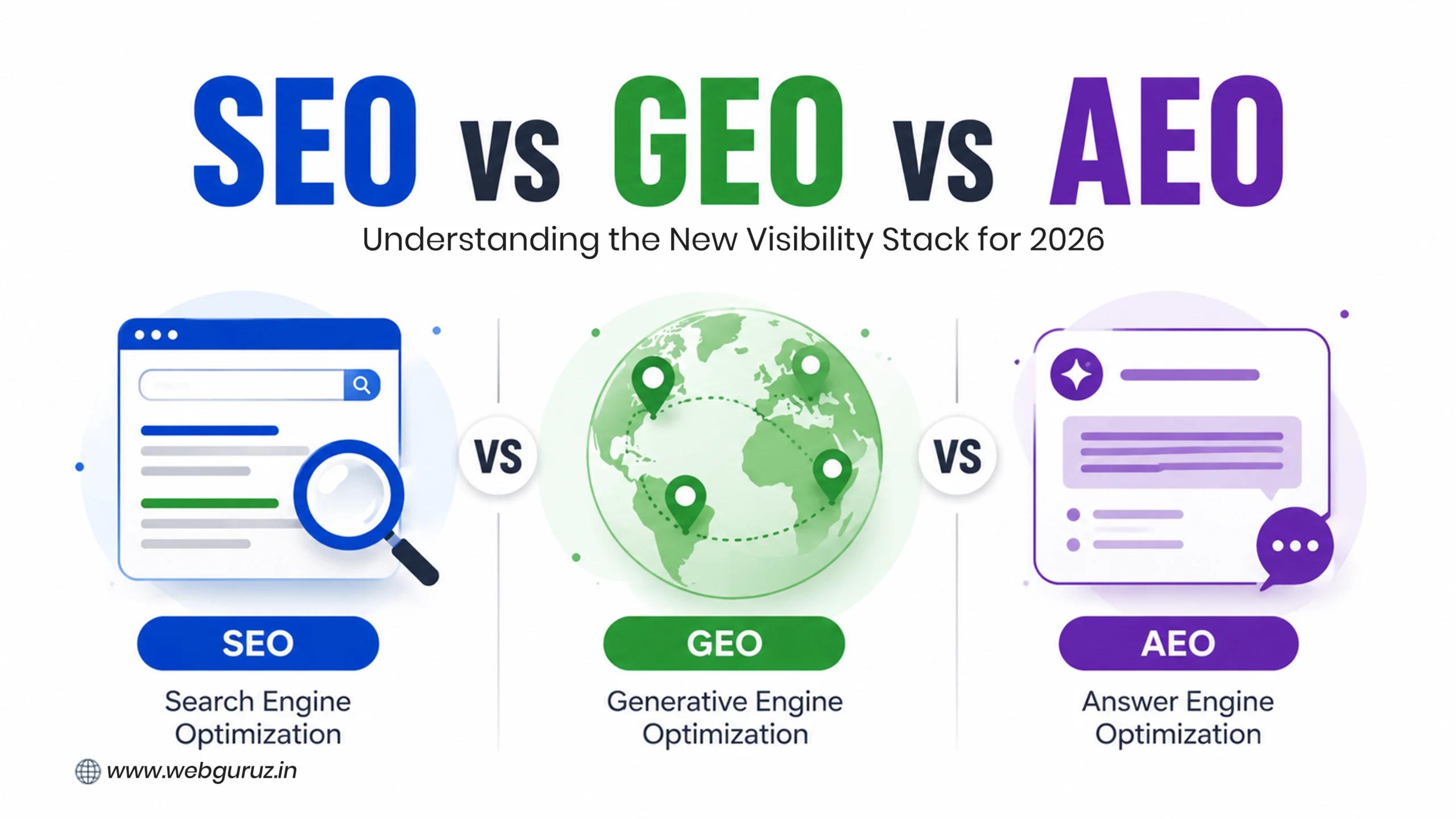
That is why businesses are now encountering three different optimization models simultaneously:
Understanding the difference between them is becoming essential for businesses trying to remain visible in SEO in 2026 and beyond.
SEO still governs traditional search rankings. GEO focuses on visibility inside AI-generated search environments like ChatGPT, Gemini, Perplexity, and SearchGPT Solutions. AEO focuses on becoming the direct answer delivered by voice assistants, AI summaries, and zero-click search experiences.
Together, these layers form what many digital strategists are beginning to call the new visibility stack.
The businesses that adapt to this shift early will not simply gain rankings. They will gain discoverability across search engines, AI assistants, conversational platforms, and answer-driven systems simultaneously. The businesses that continue treating visibility as a traditional SEO-only problem may find themselves increasingly invisible in environments where users never even reach a search results page.
This guide breaks down exactly how SEO vs GEO vs AEO works in practice, how these systems differ, and why businesses now require integrated visibility strategies rather than isolated optimization tactics.

Traditional Search Engine Optimization Services still matter enormously. In fact, SEO remains the foundational layer that supports almost every form of digital discoverability online today.
Search engines still drive a significant percentage of online journeys. According to BrightEdge research, approximately 68% of online experiences still begin with a search engine. Organic visibility continues to influence brand awareness, lead generation, customer acquisition, and long-term revenue growth across nearly every industry.
But the environment surrounding search has changed.
Google itself is transforming from a search engine into an answer engine. AI-generated overviews increasingly appear above traditional organic listings. Users now receive summarized answers before they ever click through to a website. Platforms like ChatGPT and Gemini are conditioning users to expect direct conversational responses rather than pages of ranked results.
This changes the visibility equation fundamentally.
A business can technically rank well while simultaneously losing discoverability inside AI-driven search experiences. That gap is exactly why Expert SEO Services are evolving into broader visibility strategies that combine SEO, GEO, and AEO together.
Modern professional SEO services are no longer limited to:
They increasingly involve understanding how AI systems interpret authority, how conversational engines retrieve information, and how content structures influence AI-generated outputs.
Even as search evolves, traditional SEO remains the operational foundation underneath every visibility strategy.
Modern SEO Services still directly influence:
This is where technical SEO services continue to play a critical role. AI systems still rely heavily on structured, accessible, machine-readable content. Poor website architecture, weak internal linking, slow performance, or fragmented content structures reduce visibility not only in traditional search but increasingly inside AI-generated environments as well.
Businesses working with an organic SEO agency today are often discovering that the same structural improvements that strengthen SEO also improve GEO and AEO performance simultaneously.
That overlap matters.
For example:
This convergence is why AI SEO Services are rapidly becoming one of the fastest-growing areas within modern digital strategy.
The goal is no longer simply “rank higher.”
The goal is visibility everywhere users search, ask, discover, and interact with information.

Generative Engine Optimization is emerging because AI systems retrieve information differently than traditional search engines do.
Traditional SEO focuses on ranking webpages.
Generative Engine Optimization focuses on helping AI systems understand, trust, and reference your content when generating answers.
That distinction is important.
Platforms like ChatGPT, Gemini, Claude, and Perplexity do not operate exactly like Google’s traditional ranking system. Instead of simply displaying indexed pages, these systems synthesize information from multiple trusted sources and generate contextual responses dynamically.
This changes how discoverability works.
A business may never appear as a traditional “ranking,” yet still influence AI-generated answers if its content demonstrates:
This is the foundation of Generative Engine Optimization Services.
Businesses increasingly working with a generative engine optimization agency are focusing on content structures designed specifically for AI retrieval systems rather than traditional keyword ranking models alone.
Modern generative engine optimization tools prioritize:
The shift toward GEO is happening quickly because user behavior is changing quickly.
Industry research from Gartner and Adobe trend analyses suggests that more than 55% of users now interact with AI-powered search experiences during informational discovery journeys. Users increasingly expect answers instead of links, summaries instead of research sessions, and conversational interactions instead of traditional browsing behavior.
This is where Search Everywhere Optimization becomes strategically important.
Businesses no longer compete only for rankings inside Google.
They compete for discoverability inside:
For businesses investing in AI solutions for businesses and AI integration services, this visibility shift is becoming operationally significant because discoverability increasingly affects not just traffic but brand authority itself.

Answer Engine Optimization sits even closer to direct-response search behavior.
Where GEO focuses on appearing inside generated AI responses, AEO focuses on becoming the direct answer itself.
This includes:
Answer Engine Optimization services are designed around how machines extract concise answers from content structures.
This means formatting matters differently.
Traditional SEO content often rewards depth and comprehensiveness. AEO Services reward clarity, directness, and structured responses.
AEO optimization company strategies increasingly focus on:
The growth of zero-click search behavior makes this especially important.
According to SparkToro research, nearly 60% of Google searches now end without a click. Users increasingly receive answers directly inside search interfaces without needing to visit a website at all.
That does not mean websites become irrelevant.
It means visibility itself is changing form.
Businesses working with an Answer Engine Optimization agency are optimizing for influence inside answers, not just traffic from rankings.
For many industries, particularly local services, SaaS, healthcare, finance, and consulting, becoming the extracted answer inside AI-generated experiences may soon become as commercially important as traditional organic rankings themselves.
| Factor | SEO | GEO | AEO |
|---|---|---|---|
| Primary Goal | Rank in search engines | Appear inside AI-generated responses | Become the direct answer |
| Platforms | Google, Bing | ChatGPT, Gemini, Perplexity | Google AI, Alexa, Siri |
| Optimization Focus | Rankings & organic traffic | AI visibility & citations | Direct-answer extraction |
| Content Style | Long-form & keyword-driven | Contextual & authoritative | Concise & conversational |
| Technical Priorities | Crawlability & indexing | Entity structure & semantics | Schema & answer formatting |
| Success Metric | Organic clicks | AI mentions/citations | Zero-click visibility |
The businesses seeing the strongest visibility growth are not choosing between SEO vs GEO.
They are building integrated strategies that combine all three layers together.
Visibility is fragmenting across platforms faster than most businesses realize.
Customers now discover brands through:
This fragmentation is why SEO in 2026 looks fundamentally different from SEO even three years ago.
Businesses still require Search Engine Optimization Services because search engines remain foundational.
But they also increasingly require:
This is also why many businesses are now hiring teams that combine:
The future of visibility is no longer isolated ranking performance.
It is discoverability across every environment where users search, ask, compare, evaluate, and receive information.

The most effective digital strategies now operate as layered visibility ecosystems.
SEO forms the foundation layer by improving discoverability, crawlability, and authority.
GEO builds on top of that by improving AI interpretability and generative citation potential.
AEO sits above both by optimizing content for direct-answer extraction and conversational retrieval.
The relationship looks like this:
Businesses attempting to skip foundational SEO while pursuing AI visibility often struggle because AI systems still rely heavily on structured, authoritative web content to generate reliable responses.
That is why businesses working with a certified AEO agency or an advanced Generative Engine Optimization agency are still investing heavily in foundational SEO architecture first.
The layers support each other rather than replace each other.
The conversation around SEO vs GEO vs AEO is not really about replacing SEO.
It is about understanding how digital discoverability itself is evolving.
Search engines still matter. Rankings still matter. Organic visibility still drives enormous commercial value.
But visibility no longer lives exclusively inside traditional search results.
Businesses are now competing for:
The businesses that adapt early will build durable authority across every discovery environment, shaping the future of search.
The businesses that continue optimizing exclusively for yesterday’s search ecosystem may eventually discover that visibility disappeared long before rankings did.
Yes. SEO remains the foundational visibility layer that supports both GEO and AEO performance. Traditional search rankings still drive significant traffic and authority.
Generative Engine Optimization focuses on appearing inside AI-generated responses, while Answer Engine Optimization focuses on becoming the direct extracted answer delivered by search and AI systems.
No. GEO builds on top of SEO rather than replacing it. Strong technical SEO and authoritative content remain critical for AI visibility.
Industries with high informational search intent, including SaaS, healthcare, legal, finance, consulting, and local services, often benefit significantly from AEO visibility strategies.
Because discoverability now extends beyond traditional search rankings. Businesses increasingly need experts who understand AI-driven search behavior, conversational retrieval systems, and multi-platform visibility strategy.
Vedanshi
2026-10-23
7 min read
Your business uses HubSpot to manage customer relationships, but disconnected systems create data issues.
Read More
Vedanshi
2026-10-22
7 min read
Ask ChatGPT, Gemini, or Perplexity to recommend a supplier or a software tool, and you get a short list of names, not ten blue links.
Read More
Vedanshi
2026-10-21
7 min read
Building a website takes more than picking colors, dropping in images, and writing copy.
Read More