
 +1 (213) 715-5368
Vedanshi
2026-10-23
7 min read
Custom HubSpot Integrations: Benefits, Examples, and Best Practices
Your business uses HubSpot to manage customer relationships, but disconnected systems create data issues.
Read More
Published On:2026-05-29
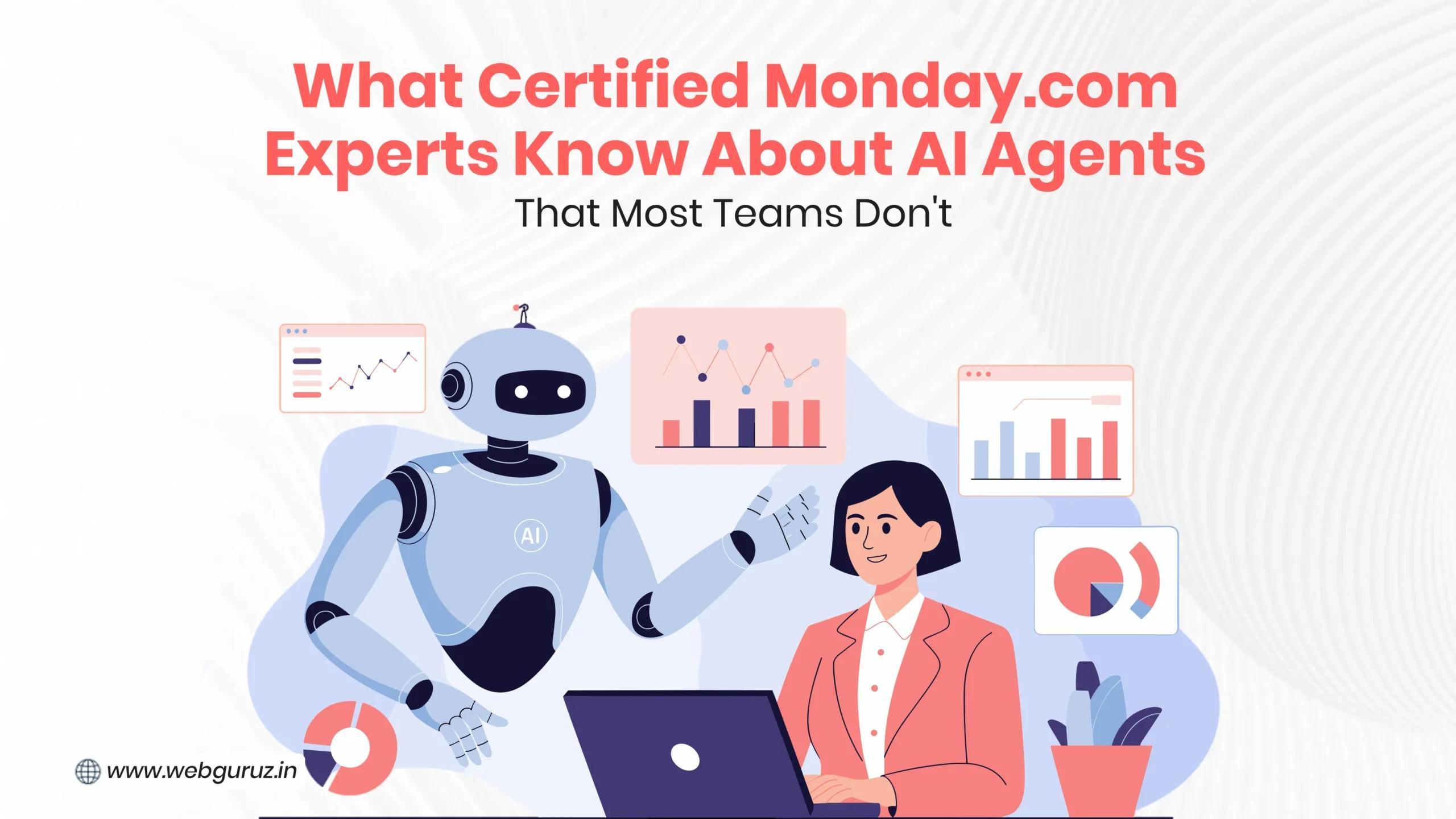
There is a gap that opens up inside almost every monday.com deployment, usually around the three- to six-month mark. The boards are built, the automations are running, and the team is using the platform. But the results feel incremental rather than transformative. Something more was promised, and it has not arrived yet.
In most cases, the gap is not a technology problem. It is a configuration and strategy problem. The platform’s AI capabilities are available, but they are not activated in a way that is connected to how the business actually operates. And the teams running the deployment do not have the architectural understanding to bridge that distance on their own.
This is the knowledge gap that Certified Monday.com Experts exist to close. Not by adding more automations or building more boards, but by understanding how AI agents work at a foundational level and using that understanding to design a Monday.com implementation that performs differently from month one.
This guide explains what that knowledge looks like in practice: how monday.com’s AI agent architecture actually functions; what it means for PMO teams, CRM and RevOps workflows, and work management across departments; and why getting the foundation right before the agents are switched on is the decision that separates organizations that transform their operations from those that add an impressive feature to their existing processes.
The most common failure mode in Monday.com AI adoption is not technical. It is conceptual. Teams approach AI agents the way they approach automation recipes, as something you configure after the process is already designed. The board is built. The workflow is established. Then someone adds an AI agent on top of it and wonders why the outputs are inconsistent, the recommendations feel generic, or the agent keeps surfacing the wrong items.
The root cause is structural. AI agents are not a feature layer. They are a reasoning layer, and the quality of their reasoning is entirely determined by the quality and structure of the data they can access. According to Gartner, only 13% of organizations believe they currently have the right governance structures in place for AI agents, highlighting how many businesses are deploying AI systems without the operational foundation needed to support them.
Monday.com’s AI agent architecture operates through a continuous cycle: observe what is happening across boards and connected systems, analyze that context against business rules and historical patterns, determine the appropriate action, execute it, monitor the result, and refine. That cycle is powerful when the underlying data is structured, consistent, and contextually rich. When boards have inconsistent naming conventions, incomplete ownership fields, missing status labels, or no defined priority hierarchy, the agent’s observation layer sees noise instead of signal, and everything downstream from that observation degrades accordingly.
Certified Monday.com experts understand this before they build anything. The configuration decisions that make AI agents reliable (data architecture, status taxonomies, ownership models, and cross-board dependency mapping) look invisible once they are in place. They are the difference between an agent that surfaces genuine insight and one that produces confident approximations.
Understanding the architecture is a strategic concern because the architectural choices made during Monday.com implementation determine the ceiling of everything an AI agent can do inside the platform.
Seven components work together to make Monday.com AI agents function. Environmental awareness is the layer that continuously monitors activity across boards, status transitions, form submissions, linked integrations, and connected applications, transforming raw board data into structured inputs that the agent can reason about. Decision-making intelligence, powered by large language models, sits on top of that observation layer and determines what response to generate based on what the agent has observed.
Strategic planning enables agents to decompose a complex directive, “prepare the quarterly PMO review,” into a sequenced set of executable actions: retrieve project board data, assess milestone completion, identify overdue dependencies, calculate capacity utilization, structure findings into a summary, and distribute it to defined stakeholders. Without this planning component, agents can only respond to individual requests. With it, they can orchestrate multi-step processes autonomously.
Contextual memory is what separates agents that behave like persistent organizational collaborators from those that treat every interaction as a fresh start. Session memory maintains context through a single workflow execution. Persistent memory allows agents to recall past decisions, reference established preferences, and build on previous outputs across separate sessions. For Monday.com PMO Solutions environments managing ongoing programs across quarters, this distinction is operationally significant.
Platform connectivity is the action layer, the capability that allows agents to create items, update statuses, send notifications, trigger integrations, and write back to connected systems rather than simply generating text. An agent without connectivity can advise. An agent with connectivity can act. Workflow coordination manages the sequencing and exception handling across multi-step executions, ensuring that when one step fails, the agent does not silently abandon the downstream chain.
Finally, dynamic knowledge access through retrieval-augmented generation allows agents to pull from organizational knowledge repositories, past project documentation, company-specific processes, product knowledge, and historical data when formulating responses. This is what makes the difference between an agent that gives generally correct answers and one that gives contextually appropriate ones for your specific organization.
Certified Monday.com experts configure all seven of these layers deliberately during implementation, not as an afterthought once the boards are live. The difference between a team that enables AI agents and a team that uses Certified Monday.com Experts to architect them is the difference between features that look impressive in a demo and agents that perform reliably in production.

Monday.com’s AI agent architecture supports four distinct operational patterns. Understanding which pattern fits which workflow is one of the most practically valuable things a Monday.com expert brings to an engagement, because applying the wrong pattern to a workflow produces an agent that technically functions but does not genuinely help.
The pattern selection is not permanent. Most mature Monday.com implementation environments use different patterns for different workflow categories simultaneously: sequential agents for operational processes, iterative agents for analytical work, and distributed systems for executive reporting.
| AI Agent Pattern | What It Does | Best Use Cases | Business Impact |
|---|---|---|---|
| Iterative Reasoning Agents | Explore information step-by-step before deciding | Risk analysis, project investigations, vendor evaluations | Better decision quality in complex workflows |
| Sequential Execution Agents | Follow predefined process sequences consistently | Client onboarding, sprint setup, compliance workflows | Reduced manual errors and operational inconsistency |
| Distributed Collaboration Systems | Coordinate multiple specialized agents simultaneously | PMO reporting, executive dashboards, cross-functional programs | Faster reporting and reduced coordination overhead |
| Platform Integration Agents | Orchestrate actions across connected tools and systems | CRM handoffs, RevOps automation, lead routing | Improved workflow speed and cross-system visibility |
Mapping those patterns to the right workflows is one of the most consistently high-value decisions that certified Monday.com experts make during an engagement.

The theoretical architecture matters less than what it enables in practice. Here is what AI agents look like when they are properly configured across the team functions that most organizations run on monday.com.
A PMO managing a portfolio of fifteen concurrent projects used to spend its Monday mornings doing something that should not require a Monday morning: aggregating status updates from fifteen different boards, identifying which projects were behind, calculating overall portfolio health, and preparing something coherent for executive review. With a properly configured AI agent in a Monday.com PMO Solutions environment, that workflow changes character entirely.
The agent runs autonomously before the Monday meeting. It queries every project board, identifies tasks that have transitioned to overdue status since the last review, cross-references those against milestone dependencies to flag which delays have downstream consequences, calculates sprint velocity against planned delivery timelines, and produces a structured portfolio summary with risk ratings. By the time the PMO director opens their laptop, the meeting preparation is done, and the meeting itself becomes a decision-making session rather than a status update session.
The same architecture applies to resource management. Rather than a manual weekly exercise of checking capacity across teams, an AI agent operating on structured Monday.com work management boards continuously monitors workload distribution and flags imbalances before they become delivery risks.
Monday.com CRM with AI agents changes the fundamental economics of sales administration. The most consistent complaint from revenue teams is not that they do not know what to do; it is that so much of their time is absorbed by the administrative work surrounding what they need to do. McKinsey estimates that generative AI could automate activities consuming up to 60-70% of employee time, particularly across administrative and operational workflows, which is why AI-enabled CRM environments are becoming a major efficiency priority for revenue teams.
Logging call notes, updating deal stages, researching account history before a follow-up call, drafting outreach emails, and routing qualified leads to the right rep are all tasks that an AI agent can handle faster, more consistently, and without the variability introduced by a team member who is also managing fifteen other priorities.
In practice, this looks like a rep completing a discovery call, their call transcript is automatically processed, the AI agent extracts key information, updates the deal record with next steps, drafts a follow-up email in the rep’s voice for review, and creates a task for the follow-up, all before the rep has finished their post-call notes. The Monday AI workflows 2026 capability that makes this possible is not speculative. It is running in production for organizations that configured their CRM boards with the structured data fields that give the AI agent what it needs to act reliably, typically under the guidance of certified Monday.com experts who understand exactly which fields, which status taxonomies, and which automation triggers enable the AI layer to perform at its best.
For Monday RevOps AI workflow environments, the agent layer operates at the pipeline level rather than the deal level. Monitoring pipeline velocity, flagging deals that have gone dark, identifying accounts showing buying signals across multiple touchpoints, and coordinating the handoff between marketing-qualified and sales-qualified pipeline stages, these are the RevOps functions that AI agents handle autonomously, freeing the RevOps team to focus on strategy rather than triage.
The insight that the monday.com reference material returns to repeatedly, and that Certified Monday.com Experts have validated through implementation experience, is that AI agents perform best when they have access to cross-functional context rather than departmental silos.
An agent that can only see the product board sees sprint velocity. An agent who can see the product board, the sales pipeline, the customer success board, and the resource management board sees that three enterprise deals in the final stages are dependent on a feature that the product team just moved from Q3 to Q4 and that this dependency has not been surfaced to anyone. That is the difference between departmental automation and organizational intelligence.
AI project management Monday in a mature implementation means agents that operate across this connected data model, not running independently within each team’s boards, but coordinating across them to surface the cross-functional risks and dependencies that siloed tools structurally cannot see.
None of this functions without the data foundation underneath it. This is the insight that separates implementations built by Certified Monday.com Experts from implementations built by competent users who are not thinking architecturally.
Structured data is not a technical nicety. It is the prerequisite for reliable agent behavior. When every board item has a clear owner, an unambiguous status from a defined taxonomy, a timeline marker, a priority designation, and the right dependency connections, agents operate with precision. They do not infer. They know.
When boards are built organically over time, with status labels that mean different things in different contexts, ownership fields left blank for items that “everyone” is responsible for, and naming conventions that reflect whoever created the board rather than an organizational standard, agents cannot be reliable. The observation layer sees an inconsistency and produces inconsistent outputs.
This is why Monday.com Implementation done well in 2026 looks different from implementation done two years ago. The question is no longer just “how do we configure boards to be usable for human teams?” It is “how do we configure the data architecture so that AI agents can operate on it reliably?” The answers to both questions are complementary; clean, well-structured boards are better for humans and necessary for agents. But the architectural thinking required to get there is different, and it is why working with certified Monday.com Experts who understand both dimensions produces materially different outcomes than configuring the platform without that expertise. Engagement with certified Monday.com experts at the design stage (before the first board is built) is consistently the decision that separates implementations that scale from implementations that plateau.
Deploying AI agents in business-critical workflows without governance controls does not accelerate transformation. It produces the kind of AI incident that results in a company-wide rollback and a six-month pause on anything AI-related.
Governance built at the architectural level (not bolted on afterwards) is what allows organizations to expand agent deployment confidently across departments. Gartner predicts that by 2027, 40% of enterprise AI agent projects will be scaled back or abandoned because of governance, security, and operational control failures, making governance architecture one of the most critical components of long-term AI success.
Role-based access controls define precisely what each agent can observe, what it can modify, and what it must escalate for human approval before executing. Audit logging captures every agent action with a timestamp and decision rationale, enabling both compliance verification and performance review. Approval workflow integration creates deliberate pause points where agents stop and request human authorization before taking consequential actions, budget modifications, external communications, and contract-related updates.
Only 11 percent of organizations have implemented governance frameworks for AI agents, according to Gartner research, despite rapid adoption growth. The gap between adoption and governance is where most AI agent programs eventually stall, not because the technology fails, but because the trust fails. Organizations that embed governance from the first day of their Monday.com implementation build trust and expand agent scope systematically. Organizations that add governance after the fact find themselves retrofitting controls into a deployment that was not designed to accommodate them. Certified Monday.com Experts treat governance architecture as a day-one deliverable, not a phase-three consideration.
Everything covered in this What Certified Monday.com Experts Know About AI Agents That Most Teams Don’t guide points to a conclusion that is both simple and demanding: the value of monday.com AI agents is real, accessible, and (for organizations that approach implementation thoughtfully) genuinely transformational. But it flows from the foundation, not from the feature.
The sequence that certified Monday.com experts follow consistently is data architecture first, governance framework second, agent configuration third, and expansion fourth. Teams that skip to agent configuration without the first two steps get agents that work in demos and underdeliver in production. Teams that invest in the foundation before switching anything on get agents that improve with every data point the organization generates.
Whether the starting point is a Monday.com PMO Solutions deployment, a Monday.com CRM configuration for a revenue team, or a Monday.com workflow solutions environment for cross-functional operations, the architectural principles are the same. The platform’s AI capabilities are designed for exactly this kind of integrated, structured, cross-functional environment. The question is whether the implementation is designed to let them perform.
Because they’re added on top of messy systems. Teams often treat AI like an upgrade instead of a foundation-level change. If your boards, data fields, and workflows aren’t structured properly, the agent doesn’t have enough clarity to make good decisions; it just produces average output faster.
Not always, but it makes a significant difference. Experts think in terms of architecture, not just setup. They design your boards, data structure, and workflows in a way that actually enables AI to perform reliably, instead of just “turning features on.”
Jumping straight into automation and agents without fixing their data structure first. Missing ownership, inconsistent statuses, and unclear priorities confuse the AI layer. Clean, structured data is what turns AI from a gimmick into something genuinely useful.
They don’t replace teams, but they remove a huge chunk of repetitive work. Things like status reporting, data updates, follow-ups, and coordination can be handled automatically, which frees teams up to focus on decisions, strategy, and execution.
A simple test: if your workflows are consistent, your data fields are complete, and your boards reflect how your business actually operates, you’re on the right track. If not, it’s worth fixing the foundation first, because that’s what determines whether AI agents actually deliver value or just create noise.
Vedanshi
2026-10-23
7 min read
Your business uses HubSpot to manage customer relationships, but disconnected systems create data issues.
Read More
Vedanshi
2026-10-22
7 min read
Ask ChatGPT, Gemini, or Perplexity to recommend a supplier or a software tool, and you get a short list of names, not ten blue links.
Read More
Vedanshi
2026-10-21
7 min read
Building a website takes more than picking colors, dropping in images, and writing copy.
Read More