
 +1 (213) 715-5368
Vedanshi
2026-10-23
7 min read
Custom HubSpot Integrations: Benefits, Examples, and Best Practices
Your business uses HubSpot to manage customer relationships, but disconnected systems create data issues.
Read More
Published On:2026-06-24
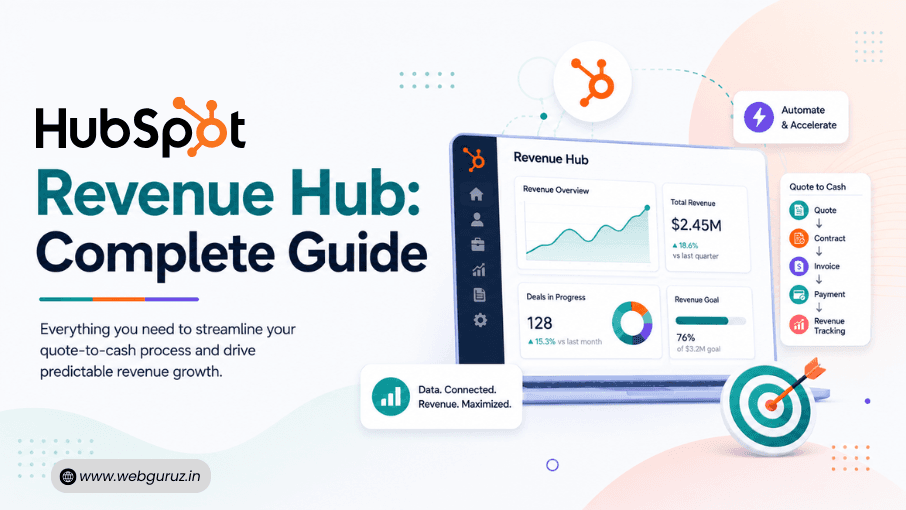
Managing revenue is no longer just about closing deals. Modern businesses need to generate quotes, manage contracts, process payments, track subscriptions, and monitor revenue performance without juggling multiple disconnected tools. As organizations embrace AI and automation, having customer and financial data spread across different platforms can create unnecessary friction and limit visibility.
This is where HubSpot Revenue Hub enters the picture. Introduced as HubSpot’s unified quote-to-cash solution, Revenue Hub is designed to bring sales, finance, and operations together on a single platform. Instead of switching between separate systems for quoting, billing, and payments, businesses can manage the entire revenue lifecycle within the HubSpot ecosystem.
The launch reflects a broader shift in how organizations approach growth. According to McKinsey’s latest State of AI report, 78% of organizations now use AI in at least one business function, highlighting the increasing demand for connected data and intelligent workflows. For AI to deliver meaningful insights, it needs access to complete and reliable business information, and that’s exactly the challenge Revenue Hub aims to solve.
Whether you’re already using other HubSpot Hubs or exploring the platform for the first time, understanding Revenue Hub can help you determine whether it’s the missing piece in your revenue operations strategy.

At its core, HubSpot Revenue Hub is a solution built to simplify and centralize the quote-to-cash process. Instead of treating quoting, contracts, billing, subscriptions, and payments as separate operational tasks, Revenue Hub brings them together within a single connected environment.
In practical terms, it allows businesses to manage the customer journey like this:
Lead → Opportunity → Quote → Contract → Invoice → Payment → Revenue Tracking
By keeping these processes connected, teams gain greater visibility into the entire customer lifecycle while reducing the need for manual handoffs between sales, finance, and operations.
Unlike a traditional CRM that primarily focuses on contacts and deals, Revenue Hub extends beyond relationship management into commercial operations. It complements existing products like HubSpot Sales Hub, HubSpot Marketing Hub, and HubSpot Service Hub, helping organizations create a more unified approach to growth.
Another key differentiator is its ability to work alongside HubSpot Commerce Hub capabilities, enabling businesses to connect customer interactions with financial transactions and recurring revenue management.
Businesses have long struggled with fragmented systems.
Sales teams often create quotes in one platform, finance manages invoices in another, contracts are stored elsewhere, and payment information lives in yet another application. This disconnect makes it harder to gain a complete understanding of customer relationships and revenue performance.
HubSpot launched Revenue Hub to address these challenges by creating a centralized environment where commercial processes can operate together rather than in isolation.
Several trends have accelerated the need for this approach:
As businesses expand, scattered information becomes increasingly difficult to manage. A centralized platform reduces duplicate work and improves collaboration across departments.
Modern AI systems perform best when they can access comprehensive business context. When quoting, billing, and CRM data exist in separate tools, automation opportunities become limited.
Today’s customer journeys involve multiple teams, from marketing and sales to finance and customer success. A shared workspace enables smoother transitions and more informed decision-making.
Maintaining multiple specialized tools often increases administrative overhead and integration complexity. Consolidating workflows into a single ecosystem can simplify operations while improving visibility.
As HubSpot continues expanding its ecosystem, Revenue Hub positions itself as an important bridge between customer relationship management and revenue operations, complementing solutions like HubSpot Data Hub and other platform capabilities.

While Revenue Hub is still evolving, its core capabilities focus on streamlining the quote-to-cash lifecycle and reducing operational silos.
Sales representatives can create, customize, and manage professional quotes directly within HubSpot, reducing reliance on disconnected quoting tools and helping speed up sales cycles.
Keeping contracts linked to customer records makes it easier for teams to access agreements, monitor commitments, and maintain consistency throughout the customer relationship.
Revenue Hub supports billing workflows that allow businesses to generate invoices and manage payment-related activities from within the HubSpot ecosystem instead of relying exclusively on external systems.
Organizations with recurring revenue models can manage subscriptions more effectively, improving visibility into renewals, upgrades, and ongoing customer relationships.
Bringing payment information into the CRM enables sales and finance teams to understand account status without switching between multiple platforms.
Centralized reporting provides a clearer picture of commercial performance by connecting pipeline activity with financial outcomes and customer data.
Because customer and revenue information reside in the same ecosystem, businesses can build smarter automations and leverage AI-driven recommendations with greater context and accuracy.
Collectively, these capabilities make Revenue Hub more than just another addition to the growing list of HubSpot Hubs. Instead, it acts as a connective layer that helps businesses manage the complete revenue lifecycle from a single platform.
Most CRM platforms are designed to help businesses organize customer information, manage pipelines, and track sales activities. While these functions remain essential, many organizations also need visibility into quoting, billing, subscriptions, payments, and revenue performance.
This is where HubSpot Revenue Hub offers a broader operational perspective.
| Traditional CRM Tools | HubSpot Revenue Hub |
|---|---|
| Focus primarily on contacts, companies, and deals | Connects quotes, contracts, billing, subscriptions, payments, and revenue data |
| Sales and finance often rely on separate systems | Brings customer-facing and revenue operations into one connected platform |
| Limited visibility into the complete quote-to-cash journey | Provides end-to-end tracking from quote creation to payment collection |
| Requires multiple integrations for commercial workflows | Centralizes revenue-related activities within the HubSpot ecosystem |
| AI capabilities may be constrained by fragmented data | Supports richer AI insights using unified customer and financial information |
| Reporting focuses mainly on pipeline performance | Combines CRM activity with revenue data for more comprehensive business reporting |
The distinction is not that traditional CRMs lack value, they remain critical for managing customer relationships. However, Revenue Hub expands that foundation by integrating commercial operations into the same ecosystem, making it easier for businesses to align teams, reduce manual processes, and prepare for AI-driven growth.
As of 2026, HubSpot Revenue Hub is positioned as part of HubSpot’s evolving product ecosystem, with features and packaging continuing to develop. Rather than functioning as a standalone tool, it is designed to integrate closely with existing HubSpot products and services, allowing businesses to manage the quote-to-cash process within a connected environment.
Pricing may vary depending on factors such as subscription tier, business size, and the specific capabilities an organization requires. Companies evaluating Revenue Hub should also consider implementation costs, integrations, user onboarding, and any customizations needed to align the platform with their existing workflows.
For businesses already using products like HubSpot Sales Hub or HubSpot Commerce Hub, Revenue Hub can often complement existing investments by extending commercial operations without introducing another disconnected platform.
Instead of focusing solely on licensing costs, organizations should evaluate the potential return on investment through improved efficiency, reduced manual work, and better visibility into revenue operations.
There is no fixed price for HubSpot Revenue Hub. The overall investment depends on your business requirements, implementation scope, and the HubSpot products you already use. The table below highlights some of the key factors that can influence pricing.
| Pricing Factor | Description | Potential Impact on Cost | Recommendation |
|---|---|---|---|
| HubSpot Plan | The subscription tier determines the Revenue Hub capabilities available to your business. | Higher-tier plans may include more advanced features and functionality. | Choose a plan based on your current needs while leaving room for future growth. |
| Number of Users | The size of your sales, finance, and operations teams affects licensing requirements. | More users can increase overall subscription costs. | Assign licenses strategically and review user access regularly. |
| Feature Requirements | Advanced workflows, subscription management, and automation may require additional capabilities. | More sophisticated requirements can increase implementation complexity. | Prioritize features that align with your business goals and ROI expectations. |
| Implementation & Onboarding | Initial setup, configuration, training, and process optimization are key to successful adoption. | Professional implementation services may add to the upfront investment but reduce long-term risks. | Work with experienced HubSpot specialists to ensure a smooth rollout and maximize value. |
Although Revenue Hub can support organizations across many sectors, certain industries stand to gain the most from a connected quote-to-cash platform.
Recurring billing, renewals, upgrades, and customer lifecycle management are central to SaaS operations. Revenue Hub helps consolidate these activities while improving visibility into subscription revenue.
Consultancies, agencies, and service providers often manage customized proposals and ongoing client engagements. Bringing quotes, contracts, and payments into one platform can reduce administrative overhead and improve project coordination.
Complex sales cycles involving multiple stakeholders require consistent collaboration between sales, finance, and customer success teams. Revenue Hub provides a shared operational foundation that supports these interactions.
Organizations with custom pricing models or negotiated agreements can streamline quoting and commercial processes while maintaining better oversight of customer commitments.
Businesses operating in highly regulated environments often need structured documentation and centralized records. A unified platform can improve process consistency and operational visibility.
The need for connected customer experiences is becoming increasingly important across industries. According to Salesforce research, 81% of customers expect companies to provide faster interactions as technology advances. This growing expectation reinforces the value of platforms that eliminate operational silos and enable teams to work from the same data.

Implementing HubSpot Revenue Hub is not simply about enabling new features. It is an opportunity to redesign workflows, improve collaboration, and establish stronger operational foundations.
A successful implementation typically follows these stages:
Before introducing new technology, businesses should document their current quote-to-cash workflows and identify pain points. This includes reviewing quoting procedures, contract approvals, billing systems, payment methods, and reporting structures.
Clean, accurate data is essential for reliable reporting and AI-driven automation. Organizations should remove duplicate records, standardize naming conventions, and verify customer information before migration or implementation.
Solutions such as HubSpot Data Hub can further support governance by helping businesses maintain consistency across systems and improve the quality of operational data.
The next step involves customizing Revenue Hub to match business requirements. This may include approval processes, subscription models, invoice generation, payment tracking, and automated notifications.
The objective is not to recreate outdated workflows but to simplify and optimize them wherever possible.
Revenue Hub delivers the greatest value when connected with other parts of the HubSpot ecosystem.
For example:
This interconnected approach reduces manual handoffs and creates a more complete view of every customer relationship.
Technology only creates value when employees understand how to use it effectively. Comprehensive onboarding, documentation, and role-specific training help ensure that sales, finance, operations, and customer success teams adopt the platform consistently.
Business requirements evolve over time, and so should revenue operations. Organizations should regularly review reports, monitor workflow performance, and identify opportunities to improve automation or eliminate unnecessary steps.
Modern businesses need more than a CRM that tracks contacts and opportunities. They need systems that connect customer relationships with the commercial processes that ultimately drive revenue.
HubSpot Revenue Hub addresses this need by bringing quoting, contracts, billing, subscriptions, payments, and revenue visibility into a unified platform. Instead of relying on fragmented tools and manual coordination, organizations can create a more streamlined quote-to-cash experience while preparing for AI-powered automation and smarter decision-making.
As businesses continue adopting integrated solutions across the broader ecosystem of HubSpot Hubs, Revenue Hub has the potential to become a key component of revenue operations, helping teams collaborate more effectively and serve customers with greater speed and consistency.
Whether you’re scaling a SaaS company, managing enterprise sales, or modernizing internal operations, Revenue Hub offers an opportunity to simplify processes and build a stronger foundation for long-term growth.
No. HubSpot Revenue Hub complements HubSpot Sales Hub by extending beyond pipeline management into quote-to-cash operations such as contracts, billing, subscriptions, and payments.
Yes. While larger organizations may have more complex revenue processes, growing businesses can also benefit from consolidating commercial workflows into a single platform and reducing reliance on multiple disconnected tools.
Absolutely. Revenue Hub is designed to integrate with products like HubSpot Marketing Hub, HubSpot Sales Hub, HubSpot Service Hub, and HubSpot Commerce Hub, creating a more unified business ecosystem.
Yes. Companies with recurring revenue models can use Revenue Hub to manage subscriptions, billing processes, payment tracking, and customer relationships more efficiently.
The timeline depends on factors such as business complexity, existing systems, and customization requirements. Organizations with well-prepared data and clearly defined workflows can typically achieve a smoother and faster implementation process.

Vedanshi
2026-10-23
7 min read
Your business uses HubSpot to manage customer relationships, but disconnected systems create data issues.
Read More
Vedanshi
2026-10-22
7 min read
Ask ChatGPT, Gemini, or Perplexity to recommend a supplier or a software tool, and you get a short list of names, not ten blue links.
Read More
Vedanshi
2026-10-21
7 min read
Building a website takes more than picking colors, dropping in images, and writing copy.
Read More