
 +1 (213) 715-5368
Vedanshi
2026-10-23
7 min read
Custom HubSpot Integrations: Benefits, Examples, and Best Practices
Your business uses HubSpot to manage customer relationships, but disconnected systems create data issues.
Read More
Published On:2026-08-04
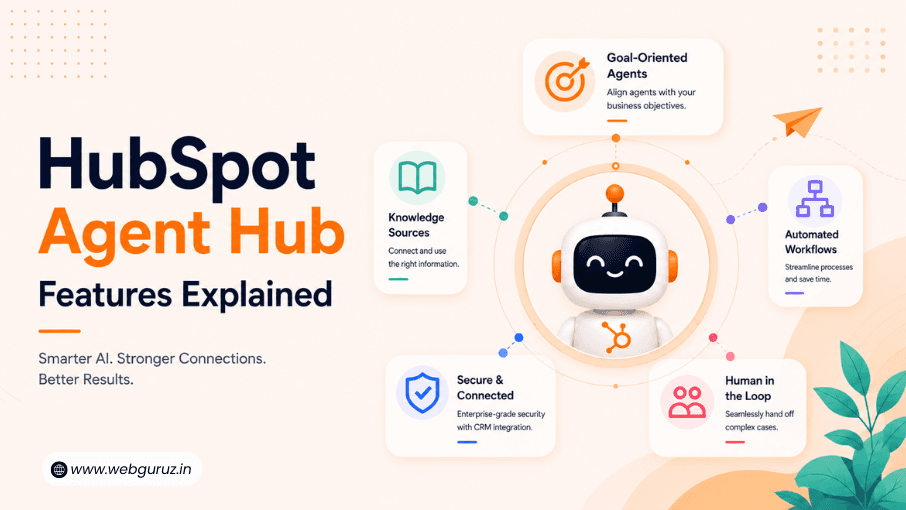
Artificial intelligence is no longer just a productivity tool, it is becoming an essential part of how businesses manage customer relationships, automate operations, and improve decision-making. CRM platforms are evolving beyond storing customer data to actively helping teams work smarter, respond faster, and deliver more personalized experiences.
This shift is exactly where HubSpot Agent Hub stands out. Instead of treating AI as an add-on, HubSpot has created a dedicated workspace where businesses can build, manage, and deploy intelligent AI agents that support marketing, sales, customer service, and operational workflows.
While our previous guide explored Agent Hub’s purpose and business value (read here), this article focuses on what businesses really want to know next: What features does HubSpot Agent Hub offer, and how can they be used to improve everyday operations?
According to Microsoft’s 2025 Work Trend Index, nearly 82% of business leaders believe this is a pivotal year to rethink key business strategies using AI, reflecting the growing demand for AI-powered business tools across industries. Businesses are no longer asking whether they should adopt AI, they are looking for practical ways to use it effectively.
In this guide, we’ll break down the platform’s most important capabilities, including Agent Builder, intelligent AI agents, workflow automation, and how these features integrate across the HubSpot ecosystem to create a more connected customer experience.
Many CRM platforms now include AI-powered features, but most of them are limited to assisting with individual tasks such as generating content, summarizing emails, or suggesting replies.
HubSpot takes a broader approach.
Rather than offering isolated AI tools, Agent Hub provides a centralized workspace where businesses can create intelligent agents that understand business objectives, access CRM data, and assist teams across multiple departments. This allows organizations to move beyond simple automation and introduce AI into everyday business processes without constantly switching between different applications.
The platform is powered by HubSpot AI, which uses customer data, business context, and connected workflows to provide more relevant assistance throughout the CRM. Instead of relying solely on predefined rules, AI can help users complete tasks based on available information, previous interactions, and organizational knowledge.
At the heart of this experience is Breeze AI, HubSpot’s AI framework that supports intelligent assistance across the platform. It enables AI capabilities such as content generation, customer support, prospect research, and workflow recommendations while keeping customer data connected within the HubSpot ecosystem.
The result is a CRM that not only stores information but also helps businesses act on it more efficiently.

One of the most valuable features inside HubSpot Agent Hub is Agent Builder. It gives businesses the flexibility to create AI agents that match their specific goals instead of relying on generic, one-size-fits-all solutions.
Every organization has unique processes, products, and customer interactions. Agent Builder allows businesses to define how an AI agent should behave, what information it can access, and which tasks it should perform. This makes it easier to build AI assistants that align with existing workflows rather than forcing teams to adapt to rigid templates.
Using Agent Builder, businesses can typically configure:
This flexibility is particularly valuable for growing organizations that want AI to support their operations while maintaining consistency in customer interactions.
Instead of replacing employees, custom AI agents work alongside teams by handling repetitive activities, surfacing relevant information, and assisting with routine decision-making. This allows employees to spend more time on conversations, strategy, and relationship-building.
The intelligence behind HubSpot Agent Hub comes from a combination of connected CRM data and advanced AI capabilities.
HubSpot AI serves as the foundation that enables businesses to use customer information more effectively across marketing, sales, and service activities. Rather than treating each interaction separately, it analyzes available CRM data to provide relevant recommendations, generate content, summarize conversations, and support decision-making.
Working alongside this foundation, Breeze AI introduces intelligent assistance that extends across multiple business processes. Instead of simply responding to commands, it helps users complete tasks faster by understanding context and recommending next steps based on customer activity and business goals.
Some practical ways businesses can use these capabilities include:
As AI capabilities continue to evolve, businesses are moving away from isolated automation toward intelligent systems that assist employees throughout the customer journey. Rather than replacing human expertise, these tools help teams make faster, more informed decisions while maintaining consistency across customer interactions.

One of the biggest advantages of HubSpot Agent Hub is that it doesn’t operate as a standalone AI tool. Instead, it works across the broader ecosystem of HubSpot Hubs, enabling businesses to bring intelligent assistance into different stages of the customer journey.
Whether a team is attracting leads, nurturing prospects, closing deals, or supporting existing customers, AI agents can access relevant CRM data and assist with day-to-day activities without requiring employees to switch between multiple platforms.
This connected approach helps businesses maintain consistent customer experiences while reducing manual work across departments. Rather than creating separate AI solutions for each function, organizations can use one centralized AI workspace that supports collaboration across the entire HubSpot ecosystem.
As businesses continue to scale, having AI integrated into existing CRM processes becomes increasingly valuable because it allows teams to make faster decisions while working from the same source of customer information.
Marketing teams are expected to produce personalized campaigns, create engaging content, analyze customer behavior, and respond quickly to changing market demands. Managing all these responsibilities manually can become increasingly challenging as businesses grow.
This is where HubSpot Marketing Hub becomes even more effective when combined with AI-powered capabilities.
Rather than replacing marketers, AI assists them by accelerating repetitive tasks and providing recommendations that improve campaign performance. Teams can spend less time on manual content preparation and more time refining strategy, understanding audience behavior, and optimizing customer experiences.
Some practical marketing use cases include:
According to HubSpot’s State of Marketing Report, marketers increasingly view AI as a productivity enhancer that helps them save time while improving the quality and personalization of their work. Rather than replacing creativity, AI gives marketing teams more time to focus on strategic decision-making.
Many businesses already rely on automation to reduce repetitive work. However, it’s important to understand that HubSpot CRM automation and workflows are complementary rather than competing capabilities.
Traditional workflows follow predefined rules. AI-powered automation adds intelligence by considering context, customer history, and available information before assisting with tasks.
The table below highlights the differences:
| Feature | HubSpot CRM Workflows | HubSpot CRM Automation with AI |
|---|---|---|
| Trigger | Rule-based | Context-aware |
| Decision-making | Predefined conditions | AI-assisted recommendations |
| Customer interactions | Automated actions | Personalized assistance |
| Flexibility | Limited to configured workflows | Adapts based on available CRM information |
| Best for | Routine operational tasks | Intelligent business support |
Businesses do not need to replace existing workflows when adopting AI. Instead, AI extends automation by helping employees make better decisions, prioritize work more effectively, and improve customer engagement.
This combination allows organizations to automate repetitive processes while still maintaining flexibility for situations that require context and human judgment.

As organizations grow, disconnected systems often become one of the biggest barriers to efficiency. Marketing, sales, customer service, and operations frequently use different processes, making collaboration more difficult and creating unnecessary manual work.
This is where HubSpot automation solutions can make a measurable difference.
By combining CRM data, AI-powered agents, and automated workflows, businesses can connect multiple departments into a single operational framework. Instead of treating automation as a collection of isolated tasks, organizations can build processes that support the complete customer lifecycle, from lead generation and nurturing to post-sale support.
Some examples include:
Rather than simply reducing workload, intelligent automation helps businesses deliver more consistent customer experiences while allowing employees to focus on higher-value responsibilities.
Although HubSpot Agent Hub is designed to simplify AI adoption, implementing AI successfully still requires thoughtful planning. Businesses need clean CRM data, clearly defined workflows, and AI agents that align with their operational goals.
This is where professional HubSpot development services can add significant value.
An experienced HubSpot partner can help businesses
Organizations that invest time in building a strong CRM foundation are generally better positioned to maximize the long-term value of AI-powered business automation.
Artificial intelligence is rapidly becoming an essential part of modern CRM platforms, but its success depends on how effectively businesses integrate it into everyday operations.
Rather than offering isolated AI features, HubSpot Agent Hub provides a centralized environment where businesses can create intelligent agents, automate repetitive work, and support teams across marketing, sales, and customer service. Features like Agent Builder, AI-powered assistance, intelligent workflows, and connected automation demonstrate how CRM technology is evolving from a system of record into a system of action.
As AI capabilities continue to mature, organizations that combine human expertise with intelligent automation will be better equipped to improve productivity, deliver personalized customer experiences, and scale more efficiently. For businesses already using HubSpot (or considering it), understanding these features is the first step toward building a smarter, future-ready CRM strategy.
Agent Builder is a feature within HubSpot Agent Hub that allows businesses to create customized AI agents tailored to their workflows, business rules, and customer interactions. It helps organizations build AI assistants that align with their unique operational needs.
Traditional chatbots usually respond to predefined questions using scripted logic. AI agents can understand context, access CRM data, and assist with more complex business tasks, making them more flexible and capable.
Yes. HubSpot Agent Hub complements existing CRM workflows rather than replacing them. Businesses can continue using rule-based automation while adding AI-powered assistance for tasks that require context and decision support.
Marketing, sales, customer service, and operations teams can all benefit. AI agents help reduce repetitive work, improve productivity, and support more personalized customer interactions across departments.
Many AI features are designed to be user-friendly, so businesses can begin using them without extensive technical expertise. However, organizations with complex integrations, custom workflows, or advanced automation requirements often benefit from professional HubSpot development support.
Vedanshi
2026-10-23
7 min read
Your business uses HubSpot to manage customer relationships, but disconnected systems create data issues.
Read More
Vedanshi
2026-10-22
7 min read
Ask ChatGPT, Gemini, or Perplexity to recommend a supplier or a software tool, and you get a short list of names, not ten blue links.
Read More
Vedanshi
2026-10-21
7 min read
Building a website takes more than picking colors, dropping in images, and writing copy.
Read More