
 +1 (213) 715-5368
Vedanshi
2026-10-23
7 min read
Custom HubSpot Integrations: Benefits, Examples, and Best Practices
Your business uses HubSpot to manage customer relationships, but disconnected systems create data issues.
Read More
Published On:2026-04-29
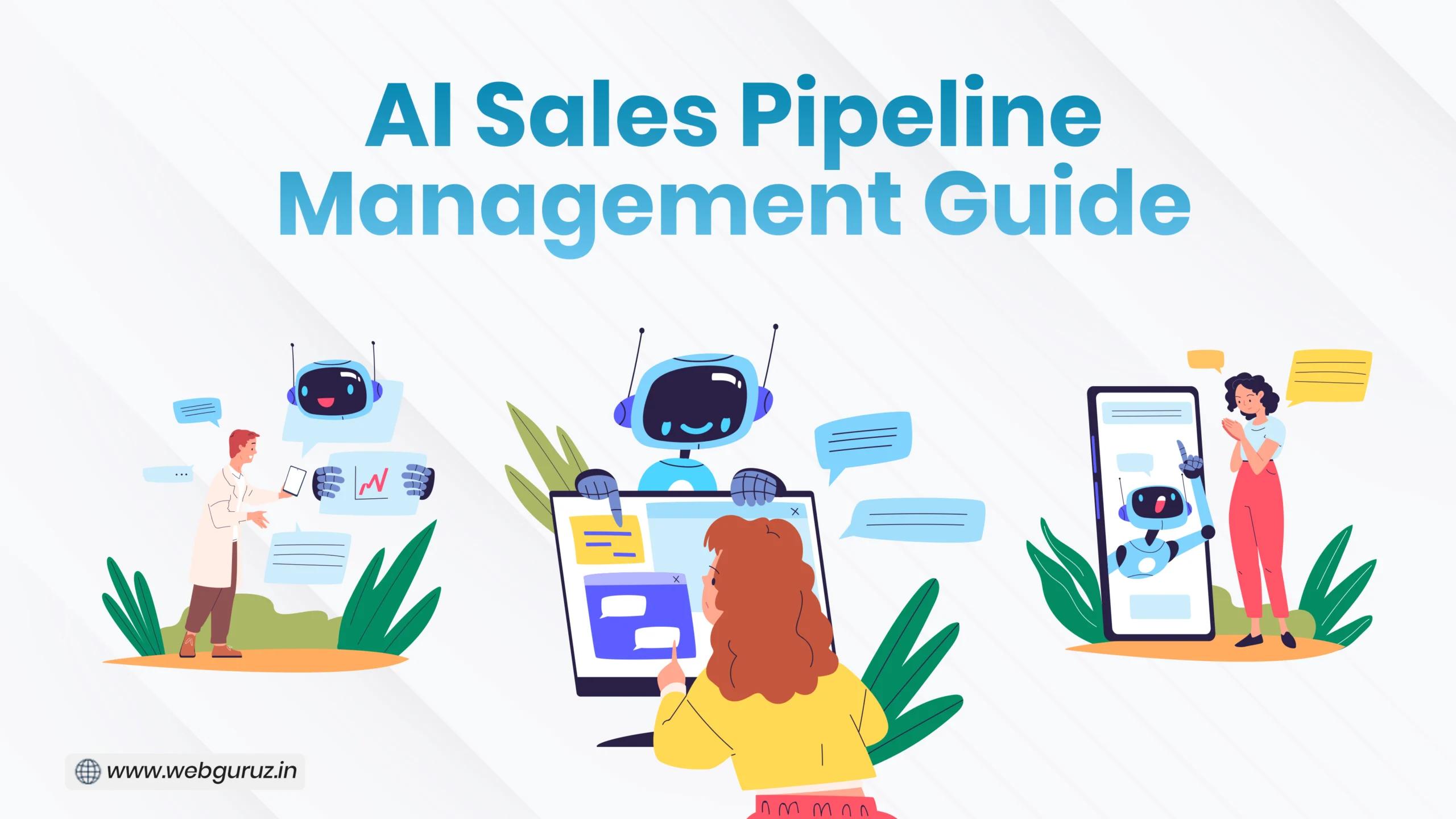
Sales pipelines have always been a management problem. The information is never quite right, the forecast is always someone’s best guess, and the CRM is perpetually one step behind what is actually happening with deals. Revenue teams have been solving for this with spreadsheets, status meetings, and gut instinct for decades.
AI changes that equation completely, but only when it is embedded in the system where your sales team actually works. A separate AI tool that nobody logs into is not a solution. An AI layer built into the platform managing your pipeline, your contacts, your deal stages, and your activity data is.
In 2026, the best CRM platforms are not databases with a reporting layer on top. They are intelligent systems that actively participate in moving deals forward, flagging risks, predicting outcomes, routing leads, and surfacing the next best action without waiting to be asked. This guide breaks down how AI-powered pipeline management actually works, which platforms are doing it best, and what revenue teams need to consider before choosing the system their entire commercial operation will run on.
Before evaluating platforms, it is worth being precise about what “AI-powered” means in a pipeline context, because the term is applied to everything from basic automation to genuinely autonomous deal management, and the difference matters.
At the foundational level, AI in pipeline management handles data capture automatically. Instead of reps logging every call, email, and meeting manually, the system pulls activity data from email, calendar, and call recording tools and attaches it to the correct deal record. This alone eliminates one of the most consistent sources of CRM data degradation, incomplete records caused by reps who are selling rather than administering.
The more sophisticated layer is predictive intelligence. AI analyzes patterns across thousands of historical deals to score current opportunities by close probability, flag deals showing signs of stalling, and generate forecasts that are grounded in behavioral signals rather than rep opinion. Organizations using AI-powered sales forecasting report a 15 percent reduction in forecast errors compared to teams relying on traditional methods, a meaningful improvement for revenue planning and resource allocation.
The most advanced layer (increasingly standard in 2026) is agentic AI: autonomous systems that take action rather than just surface insights. Professionals looking to understand how these autonomous systems plan and execute tasks can also explore an agentic ai course.
Lead routing, outreach sequencing, follow-up scheduling, and CRM record updating happen without rep input. Sales teams using AI-powered automation across the revenue cycle report 2.3x higher revenue growth compared to teams using disconnected point solutions, according to McKinsey’s State of AI in Commercial Functions report.

Sales pipelines are no longer managed through static dashboards and manual updates. Modern CRMs now act as intelligent systems that guide deals, automate workflows, and improve forecasting in real time.
The platforms below reflect different approaches to this shift, from visual collaboration to deep integrations and enterprise-grade analytics, each shaping how revenue teams operate in 2026.
Monday.com sits at a distinctive position in the CRM market: it is not a traditional CRM tool that manages customer relationships in isolation but a work operating system with CRM capabilities built on top of the same visual, collaborative infrastructure that revenue and operations teams already use for project management and delivery.
This matters in practice. Monday.com allows sales teams to manage pipeline, track deals, and run follow-up sequences in the same environment where customer onboarding, client delivery, and account management happen, on connected boards where the handoff from closed-won to post-sale execution is a workflow transition rather than a data migration to another tool.
The AI layer in Monday.com CRM is called Lexi, an AI sales agent that autonomously sources and qualifies leads, surfaces deal insights, and helps build custom automations through natural language. Rather than requiring a Salesforce admin or a developer to configure automation logic, it lets operations teams describe what they want to happen in plain language, and the AI builds the automation. AI Blocks extend this further: instant email summaries, sentiment analysis on customer communications, and revenue forecasting based on active pipeline data all operate without coding or manual configuration.
The platform also supports AI-powered lead routing through Assign label and Assign person actions that classify and route leads automatically based on text, email, activity data, and team role definitions, cutting the manual sorting that slows pipeline velocity at the top of the funnel.
Monday.com is best suited for teams that want a visual, highly customizable pipeline environment where sales and operations are not siloed systems but a connected workflow. Agencies, consulting firms, product-led businesses, and any organization where the deal does not end at contract signing will find that Monday.com CRM covers the full customer lifecycle in a way that traditional sales-only CRM tools structurally cannot.
These power one of the most widely deployed CRM environments in the world, with over 228,000 customers across the SMB and mid-market spectrum. HubSpot’s strength is its breadth: marketing, sales, service, content, and operations all sit within a single platform, sharing contact data and behavioral history across every function.
The Breeze AI layer is central to HubSpot’s 2026 pipeline management capabilities. Breeze generates email drafts personalized to deal stage and prospect behavior, predicts deal outcomes based on engagement history, and optimizes outreach timing by analyzing when individual contacts are most likely to respond. Predictive lead scoring ranks prospects by conversion likelihood, and guided selling recommendations surface the next best action at each pipeline stage.
HubSpot CRM workflows are particularly powerful for teams where inbound marketing drives the majority of the pipeline. The native connection between marketing campaigns, contact behavior tracking, and sales pipeline means that revenue teams have full visibility into what marketing activity influenced each deal and can optimize both sides of the funnel from a single data model.
The honest limitation is pricing. The jump from HubSpot’s Starter tier to Professional ($500 per month base) is steep, and once teams start adding Marketing Hub, Service Hub, and Operations Hub, costs escalate quickly. For teams that want HubSpot’s full ecosystem value, the investment is often justified. For teams that only need the sales pipeline capability, Monday.com CRM or Zoho often delivers better value at a significantly lower cost.
Zoho CRM serves over 250,000 businesses globally, consistently ranked as the best value CRM in 2026, delivering features that overlap significantly with platforms costing three to five times as much. At $14 to $52 per user per month, depending on tier, Zoho competes directly with HubSpot and Salesforce on capability while winning decisively on price.
The Zia AI assistant is central to Zoho’s pipeline intelligence. Zia detects anomalies in sales data, predicts optimal contact times, scores leads by conversion likelihood, performs sentiment analysis on customer emails, and flags at-risk deals before they stall. What differentiates Zia from many competitor AI layers is its cross-platform awareness: within the Zoho One ecosystem, Zia can see marketing engagement, support patterns, project delivery timelines, and financial data, giving it a contextual depth that siloed CRM AI cannot match.
For e-commerce businesses specifically, zoho commerce crm for e-commerce growth offers a particularly strong proposition. The combination of Zoho CRM’s pipeline management, Zoho Commerce for storefront operations, Zoho Inventory, and Zoho Books creates an integrated data model where every customer interaction (from first inquiry through purchase, support, and renewal) is visible in a single record. The revenue intelligence that Zia generates from that connected dataset is substantially richer than what any standalone e-commerce plugin to a CRM can produce.
Salesforce Services represent the benchmark for enterprise pipeline management and the platform against which every other CRM in this guide is implicitly measured. With the deepest predictive analytics, the largest app ecosystem (7,000+ integrations on AppExchange), and the most mature AI capabilities through Agentforce and Einstein, Salesforce is the natural choice for organizations with complex, multi-stakeholder deal cycles and the technical resources to configure and maintain the platform.
Agentforce introduces autonomous AI agents (including a Sales Qualification Agent, Lead Nurture Agent, Sales Coaching Agent, and Pipeline Management Agent) that operate independently to qualify leads, conduct research, and provide insights. Einstein Forecasting uses machine learning to predict quarterly revenue by analyzing pipeline health, rep performance trends, and seasonal patterns. Wiley’s implementation of Agentforce produced a greater than 40 percent increase in case resolution, and the productivity improvements across sales functions have been consistently documented across enterprise deployments.
The honest constraint is cost and complexity. Salesforce implementation requires significant technical resources, timelines routinely extend beyond initial estimates, and the total cost of ownership (base license plus Einstein add-ons plus implementation plus ongoing admin) makes it structurally unsuitable for smaller organizations. For teams evaluating Monday.com CRM against Salesforce, the question is whether the additional capability justifies not just the price difference but the implementation overhead and the organizational change management required to make Salesforce actually perform.
Microsoft Dynamics 365 consulting services serve a specific and well-defined organizational profile: enterprises that have already invested heavily in the Microsoft 365 ecosystem (Outlook, Teams, Excel, SharePoint, Power BI, and Azure) and want a CRM that integrates with those tools natively rather than through middleware.
The Sales Qualification Agent in Dynamics 365 operates independently to qualify leads and conduct research by analyzing communication history across all Microsoft applications. Copilot generates email drafts, summarizes meeting transcripts, and surfaces account insights directly within the Outlook and Teams interfaces, where enterprise reps already spend most of their working day. Power BI integration provides analytical depth that exceeds what most standalone CRM reporting engines can match, particularly for complex multi-territory, multi-product sales organizations.
The limitation is the same one that makes Dynamics compelling: its deep Microsoft integration means it performs best inside the Microsoft stack and requires considerably more effort to connect with non-Microsoft tools. For organizations outside that ecosystem, Microsoft Dynamics 365 Consulting Services engagements often reveal that the integration overhead negates the productivity advantages the platform was supposed to deliver.

The HubSpot vs. Monday CRM comparison is one of the most common evaluations revenue teams make in 2026, and it is worth addressing directly rather than leaving to a feature matrix.
HubSpot and Monday.com are not built from the same DNA. HubSpot was purpose-built as a CRM around the full revenue lifecycle, from lead generation through marketing automation to sales pipeline to customer success. Monday.com was built as a work operating system that expanded into CRM territory, which means its pipeline management is highly visual and flexible, but its marketing automation and lead scoring depth are more limited than HubSpot at comparable tiers.
For teams where inbound marketing is the primary pipeline driver and where marketing-sales alignment is a strategic priority, HubSpot wins on depth. For teams that want a visual, customizable pipeline that connects sales activity to client delivery and operations without paying for an entire marketing platform they may not need, Monday.com CRM wins on flexibility and total cost of ownership. At mid-tier, the platform’s Pro plan at approximately $28 per seat per month is significantly cheaper than HubSpot Sales Hub Professional at $500 per month base, a difference that compounds significantly as teams scale.
The right answer depends on whether your pipeline problem is primarily a sales execution problem or a marketing-sales alignment problem. Different root causes call for different tools.
No single CRM is right for every revenue team. The platform choice should follow a structured evaluation of four variables, in this order.
1. Your existing tech stack. If you are in a Microsoft-heavy enterprise, Dynamics 365 deserves serious consideration before any other platform. If HubSpot already powers your marketing, Sales Hub is the path of least resistance. If you are already using monday.com for project management and delivery, Monday.com extends that infrastructure rather than adding a disconnected system.
2. Your pipeline complexity. Simple product structures, standard deal stages, and single-territory selling work well on Monday.com, Zoho, or HubSpot. Complex multi-product, multi-territory, multi-stakeholder pipelines with CPQ requirements and revenue operations at scale begin to require Salesforce or Dynamics 365 capabilities that simpler platforms cannot replicate.
3. Your team’s technical capacity. Salesforce and Dynamics 365 both require dedicated admin resources to configure and maintain properly. Both monday.com and Zoho are configurable without specialist technical knowledge. HubSpot sits in the middle, opinionated enough to be accessible but complex enough at higher tiers to benefit from experienced implementation support.
4. Your revenue model post-close. If your revenue does not end when the deal signs (renewals, upsells, client delivery, and account management), the CRM that covers the full lifecycle matters as much as the one that manages the pipeline. Its work OS foundation makes Monday.com CRM unusually strong here, while traditional sales-only CRMs require additional tools to manage what happens after closed-won.
Everything covered in this AI-Powered Sales Pipeline Management: A Practical Guide for Revenue Teams guide points to the same underlying principle: the best pipeline management system is not the most feature-rich one; it is the one your team will actually use, that your data will actually flow through, and that your AI layer will actually learn from.
Monday.com CRM earns its place in this guide not because it is the right answer for every revenue team, but because it represents one of the most thoughtfully designed approaches to the problem: a visual, flexible, AI-augmented CRM environment that connects pipeline management to the full customer lifecycle without requiring a separate tool for every post-sale function.
Whatever platform you choose, the ROI of AI-powered pipeline management only materializes when the data foundation is clean, the workflows are configured correctly, and the team is genuinely using the system. Getting that right is the actual work, and it starts well before the first deal enters the pipeline.
AI-powered pipeline management uses machine learning and automation to track deals, predict outcomes, automate data entry, and recommend next actions, reducing manual effort and improving accuracy.
AI analyzes historical deal data, engagement patterns, and pipeline activity to generate more accurate forecasts, often reducing errors compared to manual projections.
Leading platforms include Salesforce (Einstein, Agentforce), HubSpot (Breeze AI), Zoho (Zia), Monday.com (Lexi AI), and Microsoft Dynamics 365 (Copilot).
Yes, especially platforms like Zoho and Monday.com, which offer advanced AI features at a lower cost and with less technical complexity than enterprise systems.
Key factors include data quality, existing tech stack, team adoption, workflow design, and whether the CRM supports the full customer lifecycle beyond just sales.
Vedanshi
2026-10-23
7 min read
Your business uses HubSpot to manage customer relationships, but disconnected systems create data issues.
Read More
Vedanshi
2026-10-22
7 min read
Ask ChatGPT, Gemini, or Perplexity to recommend a supplier or a software tool, and you get a short list of names, not ten blue links.
Read More
Vedanshi
2026-10-21
7 min read
Building a website takes more than picking colors, dropping in images, and writing copy.
Read More